

Mouse guide · House & home
How to Get Rid of Mice
To get rid of mice, set several snap traps about 2 metres apart along the walls where you find droppings, baited with peanut butter or chocolate, and check them every day. For a bigger problem, add bait in a lockable bait station. Then seal gaps with wire wool, as mice can get through a hole the width of a pencil.
Updated November 2026 · 9 min read

On this page
How do I know I have mice?
Mice are mainly active at night, so you will usually find the signs before you see a mouse. Look for:
Droppings
Black, rod-shaped and 3-6mm long, like a grain of rice. Fresh ones are soft and moist. Common spots are under the kitchen sink, around the boiler and in the loft.
Gnawing
Small holes in food packaging, and chewed wood, skirting or cables.
Scratching
Light, quick noises in walls, ceilings, under floors and behind kitchen units at night.
Smell
A musty smell in cupboards and enclosed spaces, left by mouse urine.
Nests
Shredded paper, fabric or insulation in quiet corners, behind appliances and in lofts.
Droppings that are much bigger and capsule-shaped usually mean rats, not mice. See our guide on how to get rid of rats.
How to get rid of mice: 7 steps
-
Find where they are active
Follow the droppings. Check under the sink, behind the cooker and fridge, inside kitchen units, around the boiler and in the loft. Where you find fresh droppings is where your traps and bait go.

Mouse droppings under a kitchen sink: black, rod-shaped and about the size of a grain of rice. Fresh droppings show where mice are active now. -
Take away their food
Clear up spilt food straight away and move cereals, dry food and pet food into sealable containers. With nothing else to eat, mice go for the bait on your traps.
-
Set plenty of traps along the walls
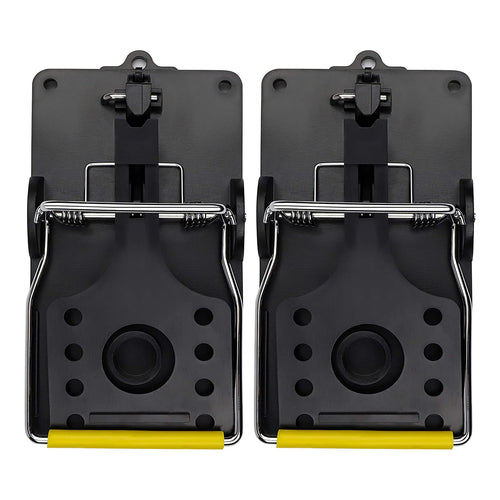
Mice run along the base of walls, so place snap traps at right angles to the wall with the baited end against it, across the route they use. Set them about 2 metres apart, or closer in small rooms. Use more traps than you think you need.

A mouse trap set at right angles to the skirting board, baited end against the wall, so a mouse running along the edge crosses the trigger. -
Bait with a small amount of something sweet
A pea-sized dab of peanut butter or chocolate spread works well. Use a small amount so the mouse has to work at the trigger to get it. If a trap isn't being visited, try a different bait or move it closer to fresh droppings.
What you need for steps 3 and 4Best sellerRatKil Mouse Traps (6 Pack)Snap traps that kill instantly. Place bait in the cup, pull back the lever and set along skirtings.£9.99View mouse trapsExtra sensitiveUltra Power Mouse Traps (4 Pack)Highly sensitive, reusable snap traps made from tough non-absorbent polystyrene.£8.99View Ultra Power -
Use bait for bigger problems or hard-to-reach spaces
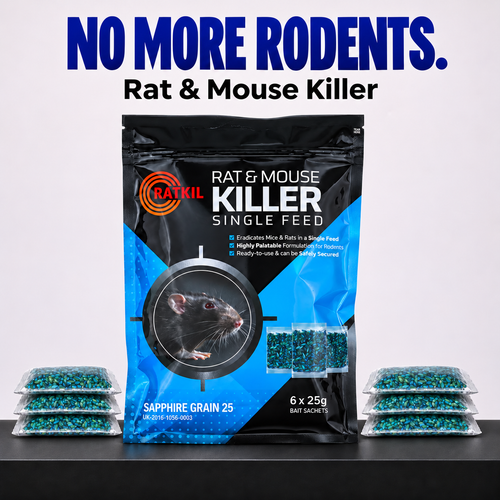
If mice are under the floor, in the loft or there are signs in several rooms, bait reaches places traps can't. Bait should be placed in a tamper-resistant bait station, and the simplest start is a lockable bait box that comes with poison grain. Under floorboards and in lofts where children and pets can't reach, grain sachets can go on bait trays. Use several small bait points where you find droppings, rather than one big one.

A locked bait station on a loft joist, close to droppings. Several small bait points work better for mice than one large one. What you need for step 5Bait + stationRatKil Rat Bait Box & Rat PoisonLock and key bait station with 150g of rat and mouse poison grain included. Suitable for indoors and outdoors.£15.99View the kitGrain baitRatKil Grain Bait (6 x 25g)Single-feed rat and mouse grain in sealed sachets, for indoor and outdoor use in and around buildings.£7.99View grain baitTight spacesRatKil Bait Trays (Pack of 10)Low-profile trays for lofts, under floorboards and behind appliances, where a bait box won't fit.£6.49View bait trays -
Check every day
Check traps every day, remove any dead mice with gloves on, and reset. Top up bait that has been eaten and keep going until no more is taken. Then remove any leftover bait straight away.
-
Seal the gaps so they can't get back in
Mice can get through a hole the width of a pencil. Pack gaps around pipes and cables with steel wire wool, not paper or cloth they can shred for nests. Fit a brush strip if you can fit a pencil under an outside door. Cover air bricks with fine mesh with holes no bigger than 6mm, but never block them.

Steel wire wool packed into the gap around a pipe under a sink. Mice can't chew through it or use it for nesting.

What to do in your situation
Mice in the kitchen
Set traps behind the fridge, cooker and dishwasher, under the sink and along the kickboards. Move dry food into sealed containers and wipe up crumbs every night, so the traps are the only food on offer.
Mice in the walls or ceiling
Mice use cavities to move between rooms. Find where they come out, often around pipes, behind units or under the stairs, and trap there. Where you can't reach, use a bait box with poison in the loft or under the floor near the noise.
Mice in the loft
Set traps along the joists where you find droppings, and use grain sachets on bait trays if children and pets can't get up there. Once they're gone, check the eaves and pipe entry points.
Mice in the car, caravan or campervan
Mice chew wiring and nest in quiet spaces. Remove food and nesting material, set traps inside overnight, then keep peppermint repellent sachets in the cabin while it's parked up.
Mice in the garage or shed
Set traps along the walls or use a bait box with poison. Store bird seed and pet food in sealed tins, and fit a brush strip if there's a gap under the door.
Children or pets at home
Put traps behind appliances and inside units where little hands and paws can't reach. If you use poison, bait should go in a lockable bait box, not on open trays.
One mouse or lots?
Each mouse can leave around 80 droppings a day, so plenty of droppings doesn't always mean lots of mice. Start with traps. If you keep catching mice or find droppings in several rooms, add bait in a bait station, as house mice breed quickly.
Every way to get rid of mice, compared
| Method | Best for | How it works | Watch out for | RatKil option |
|---|---|---|---|---|
| Snap traps | A few mice in the kitchen, cupboards, behind appliances | Kills instantly. You see each catch. | Use plenty, about 2m apart along walls; check daily | Mouse Traps (6), Ultra Power (4) |
| Bait in a bait station | Bigger infestations; lofts, under floors, garages | Mice feed from several bait points; keep topping up until no more is eaten | Bait should be in a tamper-resistant station; remove leftovers when done | Bait Box & Poison, Grain Bait |
| Humane traps | No-kill households with a small number of mice | Catches mice alive behind a one-way door | Check every day; you then need to release the mice well away from homes | Multi-catch (10), See-through (2) |
| Peppermint repellents | Lofts, cars, caravans and sheds, once mice are cleared | Strong peppermint smell mice dislike | Won't clear an active infestation on its own | Sachets, Spray |
| Ultrasonic repellers | Enclosed rooms like garages and utility rooms | Plug-in device with alternating frequencies | Results vary; use alongside traps and proofing, not instead | Ultrasonic Repeller |
| Mouse-proofing | Stopping mice coming back | Wire wool and mesh in gaps mice can't chew through | Mice fit through a pencil-width hole, so be thorough; never block air bricks | Proofing Kit |
Most homes need two things: traps or bait to clear the mice you have, and proofing to stop new ones getting in.
What's the best way to get rid of mice in the house?
Our top 5 picks for mice in the home, ranked by how well they fit the job. Most homes get the best result from pick 1, adding pick 2 for a bigger problem and pick 3 to stop them coming back.
Snap traps that kill instantly, with enough in the pack to cover a kitchen. Place bait in the cup, pull back the lever and set along skirtings.
A lock and key bait station with 150g of rat and mouse poison grain included, so you have the bait and the station in one.
Stainless steel wire wool, heavy duty shears and gloves for filling gaps, holes and cracks where mice get in.
Holds up to 10 mice at once, with two one-way entry points and a clear lid so you can see when you've caught them.
Lasts 60-90 days. Won't clear an active infestation on its own.
Also useful: Ultra Power Mouse Traps (£8.99) for extra trap points, Grain Bait 3-Pack (£15.99) for refills, Bait Trays (£6.49) for lofts and under floors, the Peppermint Spray (£9.99) for entry points, and gloves.
Always read the label before use. Browse all mouse traps, mouse poison and rodent proofing.
Questions people ask
What is the best bait for mouse traps?
Peanut butter or chocolate spread. Use a pea-sized amount so the mouse has to work at the trigger to get it, and change bait if a trap isn't being visited.
If I see one mouse, are there more?
Not always. One mouse can leave around 80 droppings a day, so a lot of droppings can come from very few mice. Set traps and see what you catch. If you keep catching mice, there are more.
Will mice leave on their own?
Not while there's food and shelter. House mice breed quickly, and their young can breed themselves within 8 to 12 weeks, so a small problem grows if it's left.
How do mice get into the house?
Through gaps the width of a pencil: around pipes and cables, under doors, through damaged air bricks and vents, and at the eaves. Seal gaps with wire wool and fit brush strips to doors.
Are mice dangerous?
Mice contaminate food with urine and droppings and can carry diseases. They also gnaw cables. Keep food sealed, and wear gloves when cleaning up droppings or handling traps.
Do ultrasonic repellers work on mice?
Results vary. They are best used in enclosed rooms such as garages and utility rooms, alongside traps and proofing, not as the only way to clear mice.
How long does it take to get rid of mice?
Traps can catch mice quickly once they are in the right places. Keep checking daily and topping up bait until no more is taken and you stop finding fresh droppings. Until gaps are sealed, new mice can move in.
What smell do mice hate?
Peppermint is the most widely used scent deterrent. It works best in enclosed spaces like lofts, cars and caravans, to keep mice away once they're cleared, rather than to clear an active problem.
More pest control guides
Not sure what you need?
Call our UK team on 01484 515 600, or browse the full range.